
Webinar
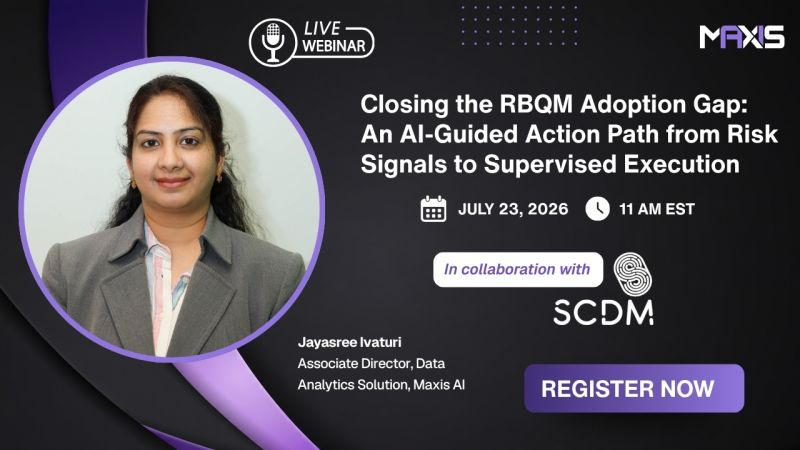
Closing the RBQM Adoption Gap: An AI-Guided Action Path from Risk Signals to Supervised Execution
Learn how supervised AI-guided action paths can turn RBQM risk signals into coordinated, documented, and inspection-ready action under ICH E6(R3).
About this webinar
Clinical development does not lack visibility into operational risk. Risk-Based Quality Management has given study teams more dashboards, key risk indicators, and central monitoring signals than ever before. The challenge is translating those signals into timely, coordinated, and documented action across functions and systems.
Under ICH E6(R3), RBQM is the operating model regulators expect across the trial lifecycle. Yet adoption remains uneven: industry research across 206 respondents and 32 RBQM components found average implementation in 57% of clinical trials, with execution trailing documentation and resolution.
This session introduces the AI-guided action path—a structured approach for moving from risk signal to supervised, documented execution. It explores how a supervised AI Workforce can support triage, follow-up, escalation, reconciliation, and documentation while preserving human validation, audit traceability, and alignment with regulated environments.
Designed for clinical data professionals navigating the evolution from Clinical Data Management to Clinical Data Science, the session shows where RBQM adoption stalls and how teams can add supervised execution capacity without compromising oversight or audit defensibility.
Key takeaways
- Where the RBQM adoption gap sits across planning, execution, and documentation—and the organizational barriers driving it.
- Why monitoring and detection alone cannot translate a risk signal into coordinated, documented, inspection-ready action.
- How a supervised AI Workforce supports triage, follow-up, escalation, reconciliation, and documentation across clinical functions.
- How human-in-the-loop validation, supervision thresholds, and logged execution history preserve oversight and audit traceability under ICH E6(R3).
- How to identify which RBQM workflows are ready for supervised execution and which require foundational process change first.
Watch On-Demand
Get instant access to practical insights on using AI to strengthen clinical data oversight, manage risk, and accelerate decisions.
Speakers

Jayasree Iyaturi
Associate Director, Data Analytics Solutions, Maxis AI
Jayasree has over 15 years of experience delivering analytics solutions using business intelligence and advanced analytical tools. She focuses on understanding key analytical challenges in pharmaceutical and clinical research environments, working closely with stakeholders across clinical operations, data management, and related functions. She specializes in building advanced analytics solutions that generate insights from clinical data, identify signals, patterns, and trends, and help break down functional silos by providing integrated, data-driven views for end users.
More webinars

Looking for Agentic AI for clinical trials?
Explore our Agentic AI Platform to see how AI agents are transforming study startup, data management, oversight, and regulatory submissions.
Explore Agentic AI PlatformExplore our AI Workforce Platform
See how AI agents are transforming study startup, data management, oversight, and regulatory submissions.