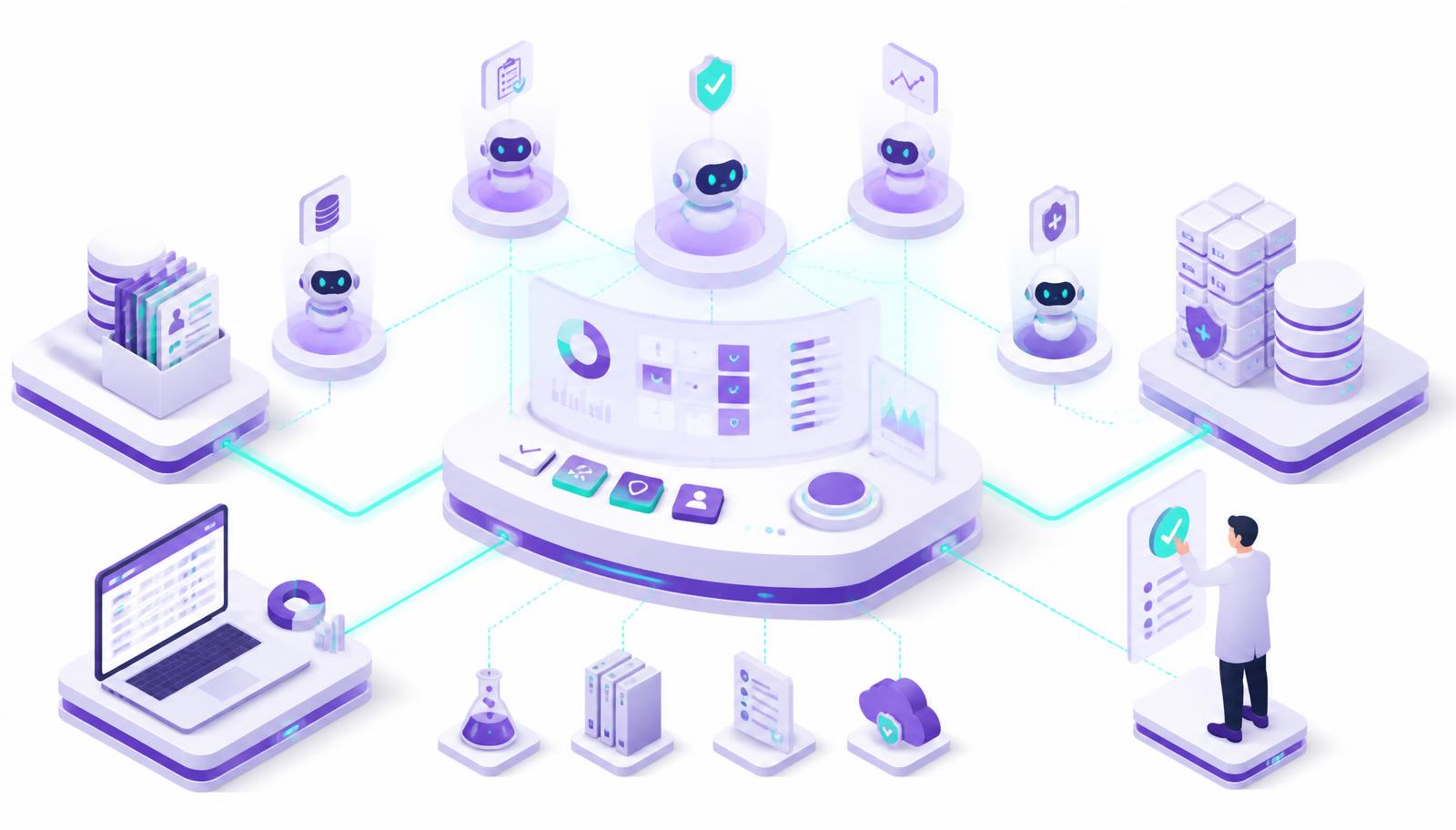

No single AI agent is going to run a clinical trial. And that may be exactly the point.
Sponsors, CROs, and clinical teams are beginning to experiment with specialized agents for protocol intelligence, data review, site operations, programming, and internal workflows.
The problem is not a shortage of agents. It is what happens when many of them enter the same clinical environment.
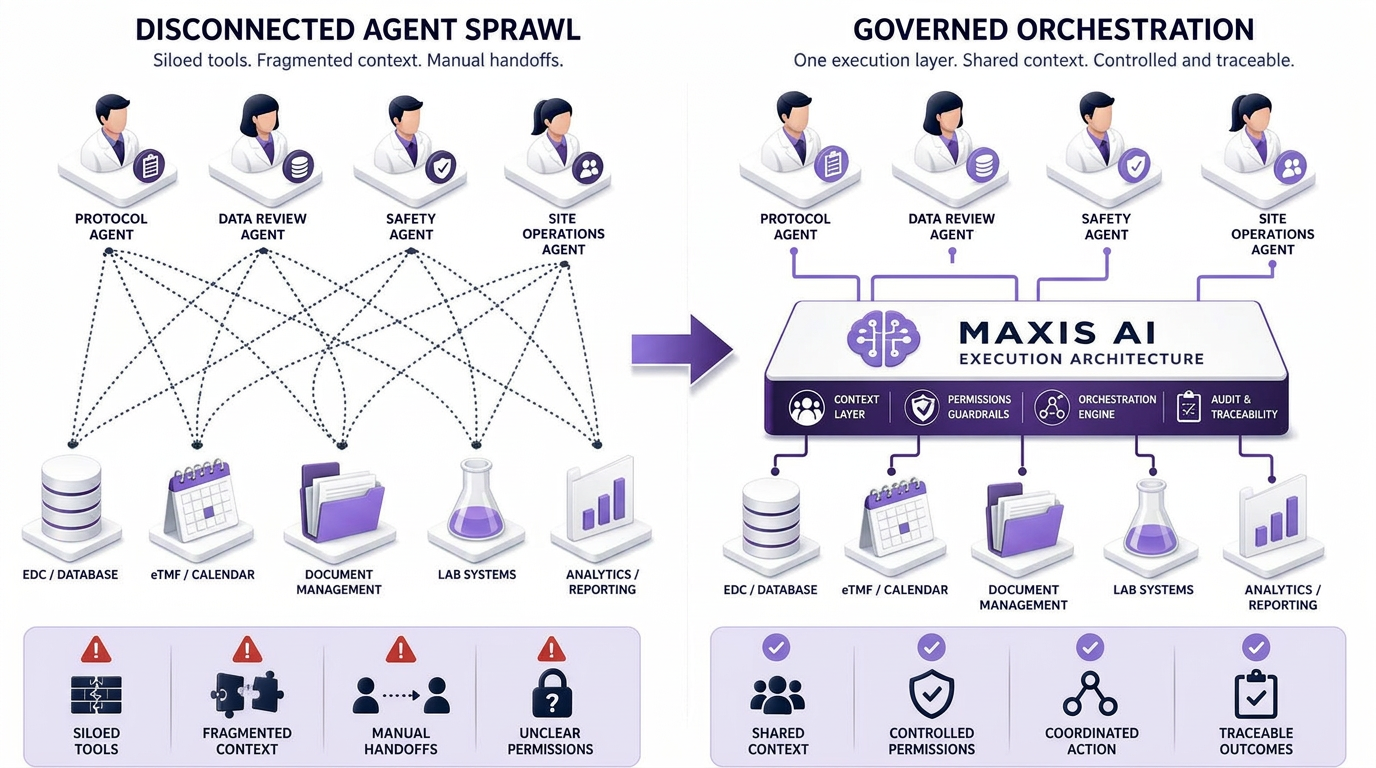
Without a common execution architecture, organizations risk replacing application sprawl with agent sprawl: disconnected agents working with different contexts, permissions, assumptions, and levels of oversight.
That is the real challenge behind Bring Your Own Agent (BYOA) in clinical trials.
BYOA should mean more than connecting another AI agent. Approved agents need a governed environment where they can use the right clinical context, work with existing systems, coordinate tasks, and remain accountable to people.
The strategic question is shifting from “Which agent should we choose?” to “What operating model will let us use different agents without losing control of clinical execution?”
The Agent Problem Is Starting to Look Familiar
Clinical development already runs across a fragmented technology landscape. EDC, CTMS, eTMF, safety, IRT, eCOA, laboratories, imaging, analytics, and internal applications each hold part of the operating picture.
AI could reduce that fragmentation. It could also make it worse.
If every function adds its own independent agent, organizations may recreate the same integration problem they have spent years trying to solve—only now the systems can reason, recommend, and act.
Research into multi-agent systems points toward a different model. Specialized agents can divide complex work and coordinate around a broader objective rather than relying on one general-purpose AI.
A 2026 scoping review of agentic AI in healthcare found growing use of goal-directed reasoning, tool use, and multi-agent collaboration, while also highlighting the need for stronger oversight and governance.
Clinical trials will face the same tension: can organizations coordinate these agents safely enough to trust the workflow?
The Real Value of BYOA Is Optionality
AI models will change. Agents will change. Internal capabilities will mature, and new specialist agents will emerge.
Clinical organizations should not have to redesign their operating environment every time the intelligence layer changes.
That is the strategic value of a BYOA strategy: architectural optionality.
A sponsor may build its own protocol agent, while a CRO or biometrics group may use specialist agents designed around their operating models.
The execution architecture should absorb those changes without forcing each workflow to be rebuilt around a new agent.
Without that layer, BYOA becomes freedom to add more software. With it, BYOA becomes an operating model.
From Agentic AI Pilots to Executable Clinical Workflows
This is the direction Moulik Shah, Founder & CEO of Maxis AI, has been positioning publicly.
"The shift is from autonomous trial execution toward human-orchestrated execution—agents carry out verifiable work while people retain judgment over decisions with clinical consequence. As organizations and vendors build specialist agents, the next need is a governed execution layer where those agents can work together in support of a Bring Your Own Agent model."
At Maxis AI INSPIRE—Agentic AI Summit 2026, held at SCOPE, Shah introduced the Maxis AI Agentic Platform in the context of moving clinical AI toward human-orchestrated execution.
At SCOPE Summit 2026, his PROJECT LOOM session explored end-to-end Agentic AI workflows where automation handles verifiable work while people retain oversight of more complex decisions.
The value of Agentic AI comes from deciding what work should be delegated, what context an agent needs, what it can do, how it coordinates, and where a person must intervene.
That is closer to designing a workforce than adding another application.
What a Practical BYOA Architecture Needs
Once several agents enter the same workflow, orchestration stops being optional.
A workable architecture needs to answer five questions:
- How do agents connect?
- What clinical context can they use?
- What actions are they allowed to perform?
- How do multiple agents coordinate?
- Where does human accountability remain?
Maxis AI approaches these questions through an AI Workforce for Clinical Trials and a System of Reasoning & Action positioned between approved agents, clinical systems, workflows, and human decision-makers.
This is the layer where BYOA becomes governable.
1. An Agent Should Never Arrive Without Boundaries
Bring Your Own Agent in pharmaceuticals should not mean that any agent can connect to any clinical system.
An agent needs clear boundaries. What can it access? Which tools can it invoke? Can it recommend an action or execute one? Does the action require approval?
The FDA and EMA's 2026 Guiding Principles of Good AI Practice in Drug Development emphasize human-centric design, risk-based controls, clear context of use, data governance, performance assessment, and lifecycle management.
FDA guidance also ties AI credibility to context of use rather than treating every AI application alike.
An agent summarizing documents carries a different risk profile from one that changes workflow state or triggers an operational action.
Governance should follow the action, not simply the presence of AI.
2. Orchestration Matters More Than the Number of Agents
Imagine a site-performance workflow.
One agent detects an emerging issue. A second retrieves the site history. A third evaluates the issue against protocol and operational context. The recommendation then reaches a clinical operations lead because the workflow requires human approval.
That is not several disconnected AI applications. It is one coordinated process using specialist capabilities.
This is what AI agent orchestration should mean in clinical trials: agents contributing to a controlled piece of clinical work.
Without orchestration, BYOA becomes agent sprawl with a new name.
3. Shared Clinical Context Is What Makes Coordination Useful
Agents cannot coordinate effectively if each sees a different version of the study.
A protocol agent may understand protocol requirements, a site agent may know site performance, and a data agent may see operational anomalies. Clinical execution often depends on how those pieces relate.
A System of Reasoning & Action brings relevant context closer to execution.
The objective is not to expose every agent to every piece of data, but to give each approved agent the context required for its role.
4. Govern the Action, Not Just the Algorithm
Traditional AI governance often concentrates on model performance, validation, explainability, and monitoring.
Agents add another dimension because they can use tools, access systems, pass information to other agents, and trigger actions.
AI agent governance therefore has to extend into the execution layer.
The NIST AI Risk Management Framework provides a useful parallel through its Govern, Map, Measure, and Manage functions, treating risk management as an ongoing lifecycle activity.
In a BYOA environment, governance should cover agent identity, authorization, data access, tool permissions, approval requirements, monitoring, change management, and deactivation.
Interoperability without control is simply another form of fragmentation.
5. Human Oversight Has to Live Inside the Workflow
Human oversight cannot be bolted onto an agent after the fact. It has to be designed into the workflow.
A 2026 review of human-in-the-loop AI in healthcare highlights the role of human involvement in safety, accountability, interpretability, and trust.
That does not mean a person needs to approve every action.
Low-risk, verifiable tasks may be automated. Ambiguous or consequential decisions may require escalation. Other workflows may let an agent prepare a recommendation while execution remains with a clinical expert.
In regulated workflows, autonomy should be designed, not assumed.
Clinical Interoperability Comes With an Audit Trail
The more agents participate in clinical execution, the more traceability matters.
Organizations need to know which agent performed an action, what information it used, whether a human intervened, and how the final outcome was reached.
ICH E6(R3) addresses system validation, controlled access, security, interfaces, change management, and audit trails. It also defines audit trails in a way that encompasses activities performed manually or automatically.
That becomes increasingly relevant as agents move from generating suggestions to participating in operational workflows.
The more an AI system can act, the more important it becomes to understand exactly what it did.
What BYOA Could Look Like in Practice
Consider study startup.
A sponsor's internal protocol agent identifies country-specific requirements. A site agent evaluates available site information. Another checks previous operational history.
The execution layer brings those inputs together and routes the proposed action to the appropriate study lead.
Or consider clinical data management.
One agent detects an unusual pattern. Another gathers supporting evidence. A third determines whether the issue meets predefined escalation criteria.
The data manager receives the issue with relevant context already assembled.
Not every workflow needs several agents. The architecture should support specialization when it adds value, while the clinical operating model remains consistent.
Four Questions Sponsors and CROs Should Ask
Before adopting BYOA, clinical organizations should ask four questions.
Can we control what every agent can see and do?
If permissions are unclear, the architecture is not ready.
Can agents share enough context to work together without breaking data boundaries?
More context is not always better. The right context is what matters.
Can we trace every meaningful recommendation and action?
Clinical execution should remain explainable even when several agents contribute to the workflow.
Can we replace or add agents without rebuilding the operating model?
This may be the most important strategic question.
Models will evolve. Agents will come and go.
The execution architecture should outlive them.
Where Maxis AI Fits
Maxis AI's approach to Bring Your Own Agent (BYOA) in clinical trials is built around that principle.
Different agents may come from different places. The governance model should not.
The Maxis AI System of Reasoning & Action provides orchestration, clinical context, permissions, workflow controls, human supervision, and traceability to turn specialist agents into part of an AI Workforce for Clinical Trials.
The objective is not to accumulate more AI. It is to let organizations choose the right intelligence for the job without redesigning clinical execution every time the technology changes.
Done well, this also lets teams expand clinical execution capacity as agents take on structured, verifiable work under supervision, without scaling headcount in step with trial volume.
The winners in clinical AI will not necessarily be the organizations with the most agents.
They will be the ones that know how to govern, orchestrate, and change those agents without losing control of the trial.
That is the real promise of BYOA: a clinical execution model that can absorb whatever comes next.
Frequently Asked Questions
Frequently asked questions
What is BYOA in clinical trials?
Why do clinical trials need AI agent orchestration?
What is AI agent governance?
Can organizations bring internally developed agents into a BYOA model?
What is the main advantage of BYOA?
References
Sources & references
- Coordinated AI agents for advancing healthcare — Nature Biomedical Engineering, 2025
- The role of agentic artificial intelligence in healthcare: a scoping review — NPJ Digital Medicine, 2026
- INSPIRE: Agentic AI Summit at SCOPE 2026 — Maxis AI
- SCOPE Summit 2026: PROJECT LOOM and Agentic AI Workflows — Maxis AI
- Guiding Principles of Good AI Practice in Drug Development — U.S. Food and Drug Administration, 2026
- Considerations for the Use of Artificial Intelligence to Support Regulatory Decision-Making for Drug and Biological Products — U.S. Food and Drug Administration, 2025
- Artificial Intelligence Risk Management Framework (AI RMF 1.0) — National Institute of Standards and Technology, 2023
- Human in the loop artificial intelligence in healthcare: applications, outcomes, and implementation challenges — International Journal of Medical Informatics, 2026
- ICH E6(R3): Guideline for Good Clinical Practice—Final Consolidated Guideline — International Council for Harmonisation, 2026

About the author
Nisha Panwar
Content & Research, Maxis AI
Nisha Panwar is a content and research professional with more than five years of experience across clinical research, scientific writing, and pharmaceutical technology. Her work focuses on translating developments in clinical trials and Agentic AI into clear, practical insights for clinical development teams. She writes about how emerging technologies, including the AI Workforce for Clinical Trials, are reshaping clinical operations, decision-making, and study execution.