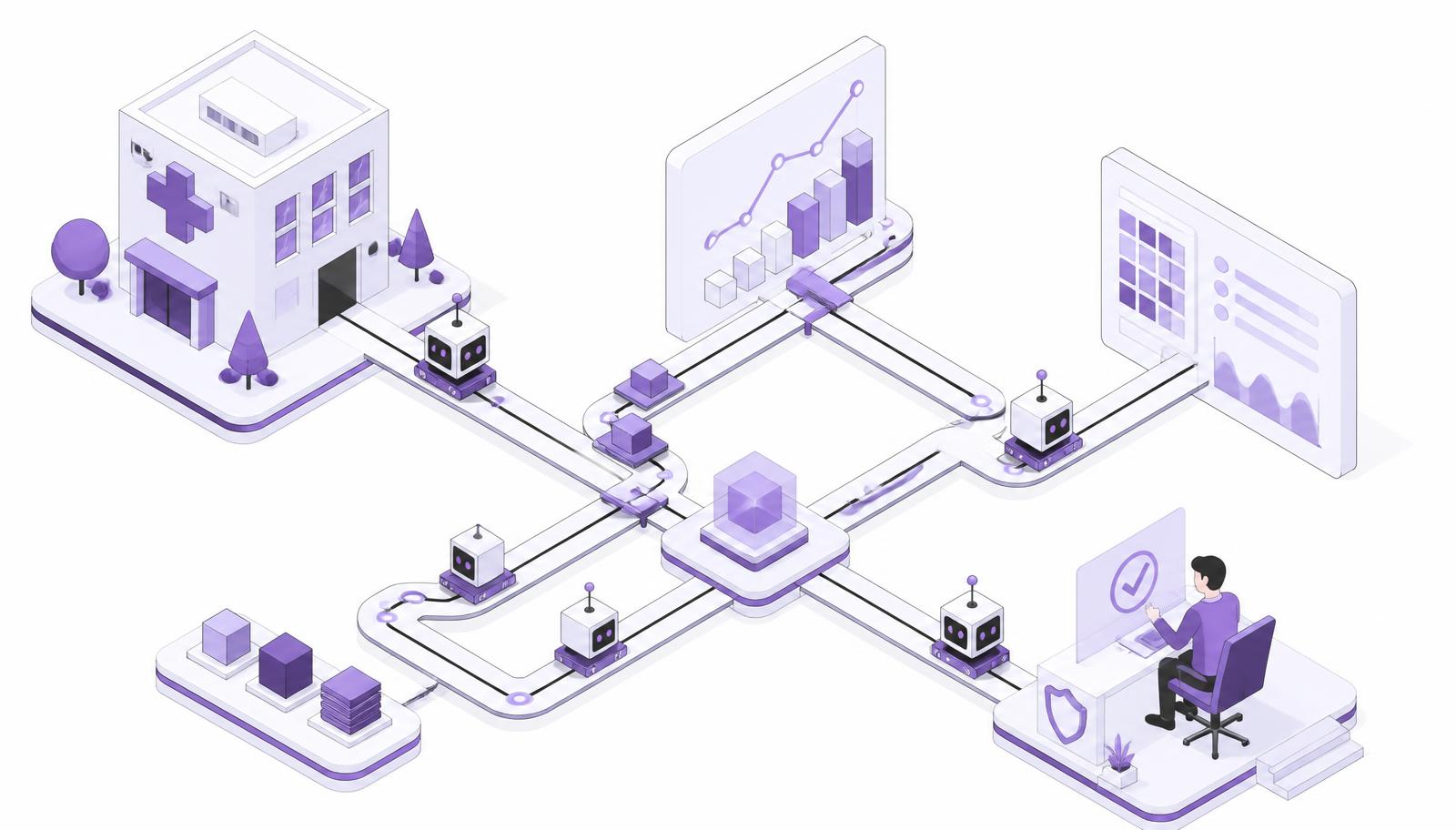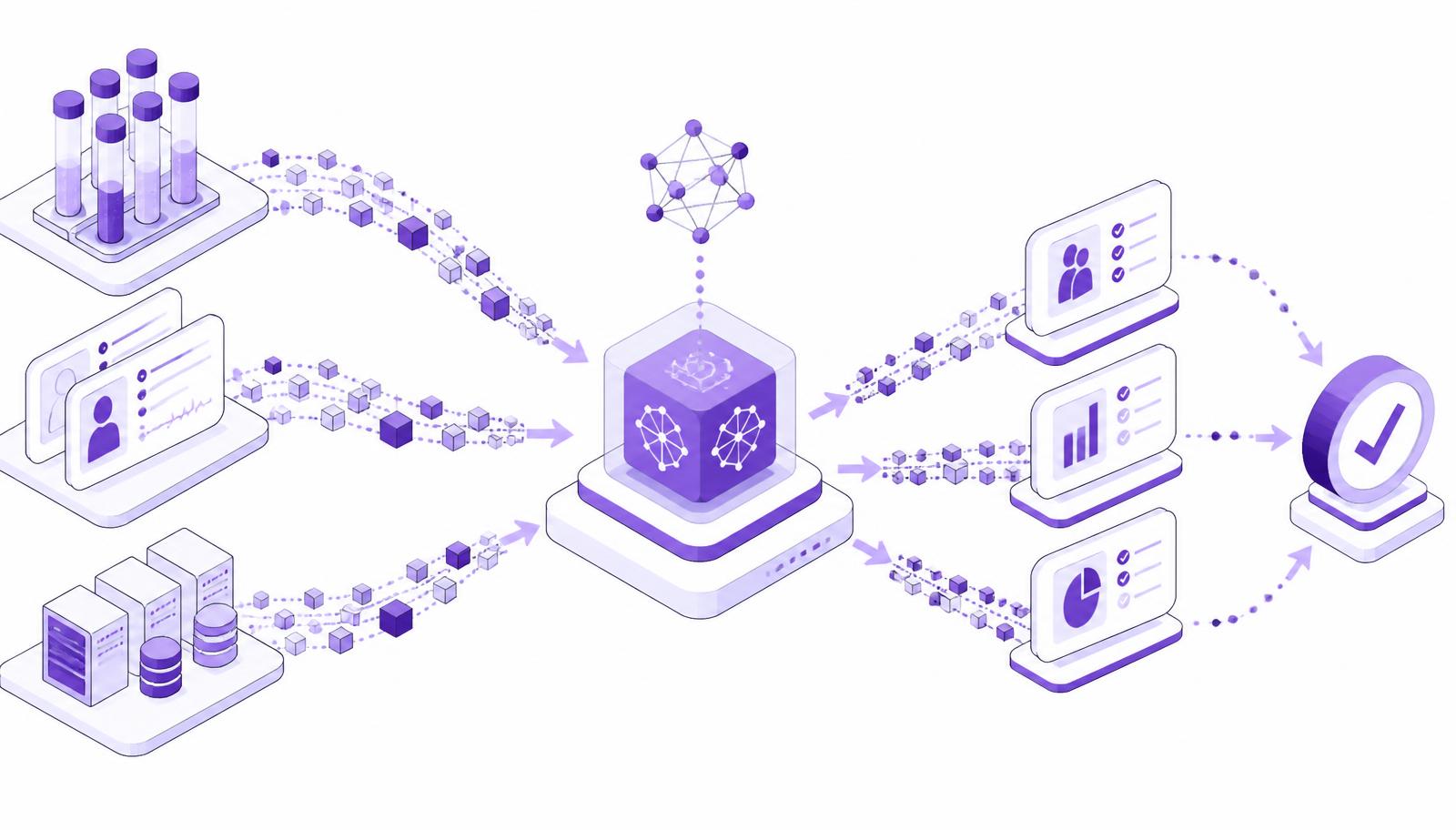

Clinical trial delivery is moving from headcount scaling to governed execution scaling. The question is what fills the gap between visibility and action.
Agentic CRO describes a shift already underway in clinical service delivery: from execution capacity built on headcount to execution capacity built on governed, AI-supported workflows. Clinical trials have become more complex, distributed, and operationally demanding. The CRO market is also being reshaped by advances in AI, new regulatory expectations, scientific complexity, consolidation, and rising digital transformation costs that are putting pressure on mid-tier CRO delivery models.[1]
For years, the standard response was the same: add more people, project management, and coordination layers. That model is reaching its structural limits—not because CRO teams lack expertise, but because manual coordination still converts visibility into action. The next evolution of CRO delivery has a name: the Agentic CRO.
What Is an Agentic CRO?
An Agentic CRO is a clinical service delivery model where human clinical experts are supported by governed AI agents that can monitor defined workflows, identify execution risks, prioritize next steps, and support controlled action across the clinical trial lifecycle under expert supervision, within regulated environments, and with full audit traceability.
This is not a rebranding of digital CRO delivery. It is not a claim that AI will replace clinical operations teams. And it is not another dashboard.
The Agentic CRO represents a shift in how execution capacity is structured: from a model built on headcount, to a model built on supervised intelligent execution. Clinical development does not lack visibility into operational risk. What it consistently lacks is scalable execution capacity - the ability to move from knowing what needs to happen to actually making it happen, consistently, across complex multi-site, multi-vendor environments. This is the same structural challenge explored in the clinical trial execution gap.
Why the Traditional CRO Model Is Under Pressure
The traditional CRO model still has strong foundations: therapeutic expertise, experienced clinical teams, process discipline, and site relationships. But the delivery environment has changed. Trials now involve more sites, vendors, systems, and handoffs. This has made execution harder to manage through manual coordination alone.
Workforce instability adds execution risk
Clinical trial delivery still depends heavily on people. Site-level workforce instability makes that dependency harder to manage.
- SCRS has reported annual turnover rates of roughly 35% to 61% for patient-facing site staff.[2]
- ACRP has cited an estimated $50,000 to $60,000 cost to replace a clinical research coordinator, excluding lost productivity and added burden on remaining staff.[3]
- In a headcount-based model, turnover affects execution continuity as well as staffing.
For a delivery model built primarily on adding headcount, this volatility creates a direct operational risk.
Every point of turnover can become a point of execution delay.
Systems create visibility, not resolution
Modern trials run across CTMS, EDC, eTMF, IRT, safety databases, enrollment tools, site portals, and vendor workflows. These systems show what is happening. They do not coordinate what should happen next.
Teams still need to determine:
- Who owns the issue
- What action is required
- What needs escalation
- What must be documented
Execution fragmentation is the real constraint
In the traditional model, people connect signals across systems manually. That work repeats across every site, vendor, workflow, and protocol change. Execution fragmentation is the gap between seeing a risk and resolving it through governed action.
The Real Constraint Is Execution, Not Visibility
Seeing a risk earlier does not resolve it. An enrollment shortfall still needs an owner. A protocol deviation trend still needs escalation. A query backlog still needs a documented response.
Better visibility helps teams detect issues sooner, but it does not create capacity to act on every signal.
This is where the Agentic CRO opportunity becomes clear. Clinical development does not lack more dashboards. It lacks scalable execution capacity to turn operational signals into governed action.
Without that layer, faster detection only moves the bottleneck from identifying risk to resolving it.
From Headcount Scaling to Execution Scaling
The most important shift the Agentic CRO introduces is architectural. Traditional CRO delivery scales through headcount. More studies mean more teams. More complexity means more coordination layers and more oversight staff. That model is already under visible strain. Biopharma layoffs remained elevated through 2025, with industry reporting showing sustained workforce reductions across the sector.[4] CROs have also faced customer budget pressure, study delays, and resource realignment, as seen in reported market headwinds affecting major CROs.[5] The Agentic CRO introduces a different kind of scaling: execution scaling.
Execution scaling means increasing capacity to move defined clinical workflows forward without matching every increment of work with proportional manual effort. In an Agentic CRO model, governed AI agents can support repeatable operational workflows across startup, enrollment coordination, data management, query resolution, document readiness, and risk oversight—within defined boundaries, under expert supervision, with human validation thresholds at every decision point that matters.
This does not remove human judgment from clinical operations. It increases the execution capacity that surrounds it. Clinical teams spend less time chasing status across disconnected systems, and more time managing exceptions, making decisions, and applying the expertise that requires regulatory accountability.
"The Agentic CRO does not remove human accountability from clinical service delivery. It increases governed execution capacity around clinical teams, so rising trial complexity does not have to translate directly into rising headcount."
Traditional CRO vs. Tech-Enabled CRO vs. Agentic CRO
The Agentic CRO is often confused with the tech-enabled CRO. They are not the same. A tech-enabled CRO helps teams see more. An Agentic CRO helps teams do more, with governed consistency and traceability built into the execution layer itself.
| Dimension | Traditional CRO | Tech-Enabled CRO | Agentic CRO |
|---|---|---|---|
| How it scales | Headcount and manual coordination | Digital platforms and dashboards | Governed AI execution capacity |
| Primary value | Deep clinical expertise and service depth | Improved operational visibility | Scalable, supervised execution across workflows |
| Signal-to-action | Manual and dependent on available headcount | Insight generation; action remains manual | Supervised AI prepares and routes action |
| Key limitation | Coordination-heavy as complexity increases | Visibility without resolution capacity | Requires strong governance, validation, and oversight |
What Makes a CRO Agentic?
The word “agentic” should mean something specific when applied to clinical service delivery. Agentic is not a synonym for uses AI. It describes a delivery model built on five defining capabilities.
AI agents embedded into clinical workflows
Agents are not general-purpose assistants layered on top of operations. They are embedded into defined clinical workflows—startup readiness, enrollment monitoring, query management, site communication, document tracking, and risk detection—where they support governed action within bounded parameters. The AI Workforce for Clinical Trials shows how these role-specific agents operate under supervision.
Integration with existing systems of record
Agentic delivery does not require replacing clinical infrastructure. It creates a supervised execution layer that connects with and acts across existing systems—CTMS, EDC, eTMF, safety environments, and analytics platforms.
Human-in-the-loop governance
Humans remain accountable for decisions, approvals, exceptions, escalations, and final oversight. AI agents support the workflow; they do not operate outside it. Every consequential step remains governed by defined human review thresholds.
Audit traceability
What triggered each action? What data was reviewed? Who validated it? In a regulated clinical environment, every step must be traceable. Agentic delivery is viable only when auditability is built into the architecture, not added afterward.
Controlled execution, not open-ended autonomy
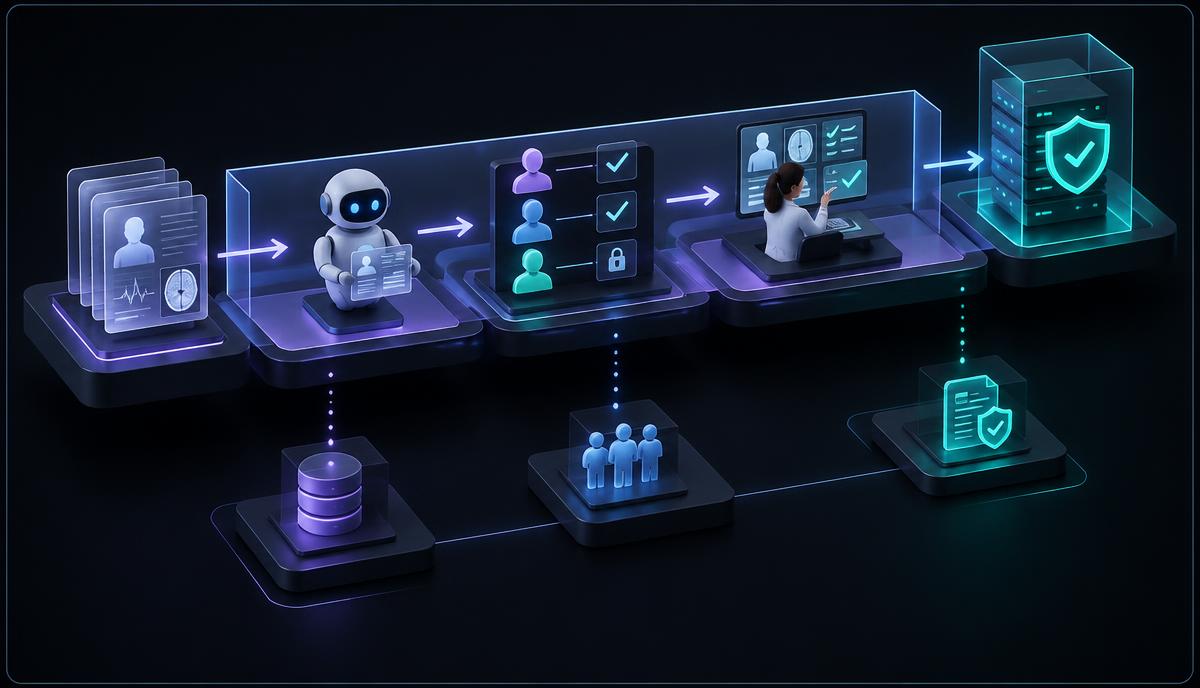
The strongest Agentic CRO models use controlled, rule-based, validated execution—not unrestricted AI behavior. Clinical operations cannot tolerate black-box decisions. Governance is not a feature; it is the foundation.
Governance Will Determine What Scales
Agentic delivery cannot rely on open-ended autonomy in a regulated environment. Regulatory direction is moving toward risk-based, documented, human-centered AI use. In January 2026, EMA and FDA jointly identified ten principles for good AI practice across the medicine lifecycle, including human-centric design, risk-based controls, data governance, documentation, lifecycle management, and clear context of use.[6][7]
FDA draft guidance on AI used to support regulatory decision-making also reinforces the need for a risk-based credibility assessment framework, documentation, context of use, and model-risk evaluation where AI is used to produce information or data for regulatory decisions.[8] Not every CRO operational AI use case falls directly within that draft guidance. However, its principles are still useful for sponsors and CROs evaluating how governed AI should be assessed, documented, and controlled.
For sponsors and CROs evaluating the Agentic CRO model, four controls matter most:
Role-based access
Every action is controlled by who is permitted to take it. Permissions are explicit, and the AI Workforce operates only within the workflow scope it has been granted.
Human validation checkpoints
Agents prepare and route work, but defined decisions return to a person for review and approval. Oversight sits at every point that matters, not bolted on at the end.
Audit traceability and explainability
Every step is logged and explainable, so the path from signal to action can be reconstructed on demand—inspection-ready by design rather than reassembled under pressure.
Reproducible execution
The same workflow produces consistent, defensible output across repeated conditions. Ungoverned execution will not survive inspection; reproducible, governed execution is what compounds across a portfolio.
"The Agentic CRO is not a marketing label. It is a new clinical service delivery model built around governed execution, AI-supported workflows, and human accountability."
The Future of Clinical Service Delivery
The CRO model is not disappearing. Expertise, site relationships, therapeutic knowledge, and regulatory discipline remain foundational to clinical trial execution. What is changing is the operating model surrounding that expertise.
The next phase of clinical service delivery will be human-led, AI-supported, and governance-first—built on supervised intelligent execution rather than manual coordination, on execution scaling rather than headcount scaling, and on governed action rather than fragmented follow-up.
Maxis AI has been building toward this shift through its AI Workforce for Clinical Trials, a supervised execution layer designed to support exactly this kind of governed, accountable scaling across clinical operations.
The gap between visibility and governed action is where trials slow down, where costs accumulate, and where timelines become unpredictable. The Agentic CRO closes that gap.
Frequently Asked Questions
Frequently asked questions
What is an Agentic CRO?
Is an Agentic CRO the same as a tech-enabled CRO?
Does the Agentic CRO model replace clinical operations teams?
What does execution scaling mean?
Why does governance matter in an Agentic CRO model?
How does an Agentic CRO connect to Agentic OS and Control Tower?
What role does an AI Workforce play?
Sources & References
Sources & references
- CRO Industry Outlook 2026: The Next Stage of Clinical Trial Transformation — Clinical Leader, 2025
- Fixing the Foundations: A New Model to Solve Clinical Site Staffing and Retention Challenges — Society for Clinical Research Sites, 2025
- Navigating Workforce Stability in Clinical Research — Association of Clinical Research Professionals, 2025
- Q3 Biopharma Layoffs Hold Steady — Fierce Biotech, 2025
- Irish CRO Icon Plots Layoffs After Underwhelming Q3 Revenue — Fierce Biotech, 2024
- EMA and FDA Set Common Principles for AI in Medicine Development — European Medicines Agency, 2026
- Guiding Principles of Good AI Practice in Drug Development — U.S. Food and Drug Administration, 2026
- Considerations for the Use of Artificial Intelligence to Support Regulatory Decision-Making — U.S. Food and Drug Administration, 2025

About the author
Nisha Panwar
Content & Research, Maxis AI
Nisha Panwar is a content and research professional with more than five years of experience across clinical research, scientific writing, and pharmaceutical technology. Her work focuses on translating developments in clinical trials and Agentic AI into clear, practical insights for clinical development teams. She writes about how emerging technologies, including the AI Workforce for Clinical Trials, are reshaping clinical operations, decision-making, and study execution.