Much of the late-stage submission rework is not caused by missing documents alone. It stems from documents that quietly disagree: a clinical study report (CSR) table updated after an analysis rerun while the efficacy summary still quotes the old number, an adverse-event total that differs between modules, a citation pointing to a superseded output. Each change was approved. It just never reaches every document that depends on it.
That gap is where agentic AI for regulatory submissions earns its place. Why does it matter? One outdated figure found in final review means a CSR revision, document re-approval, and a publishing delay right before filing.
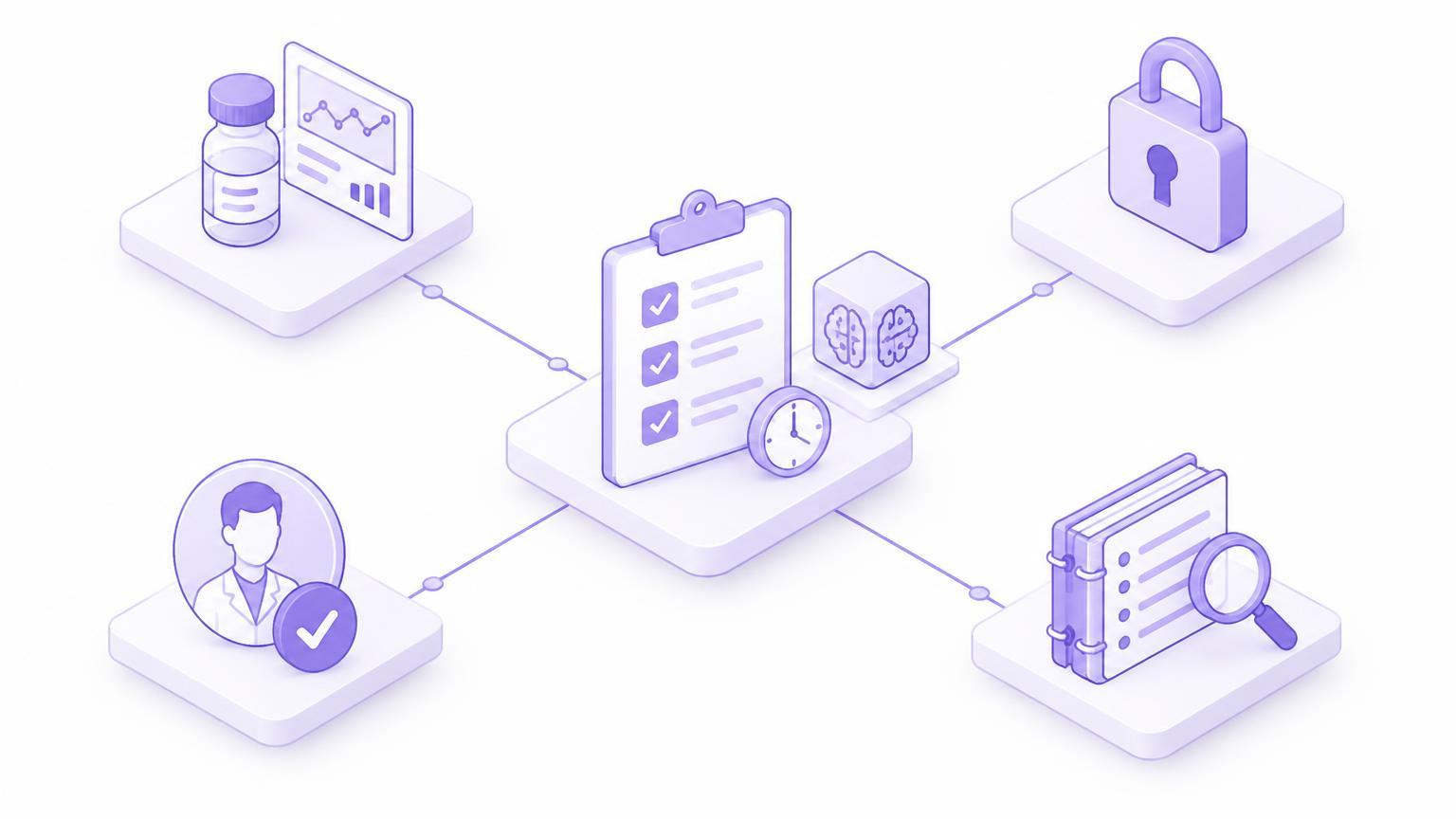
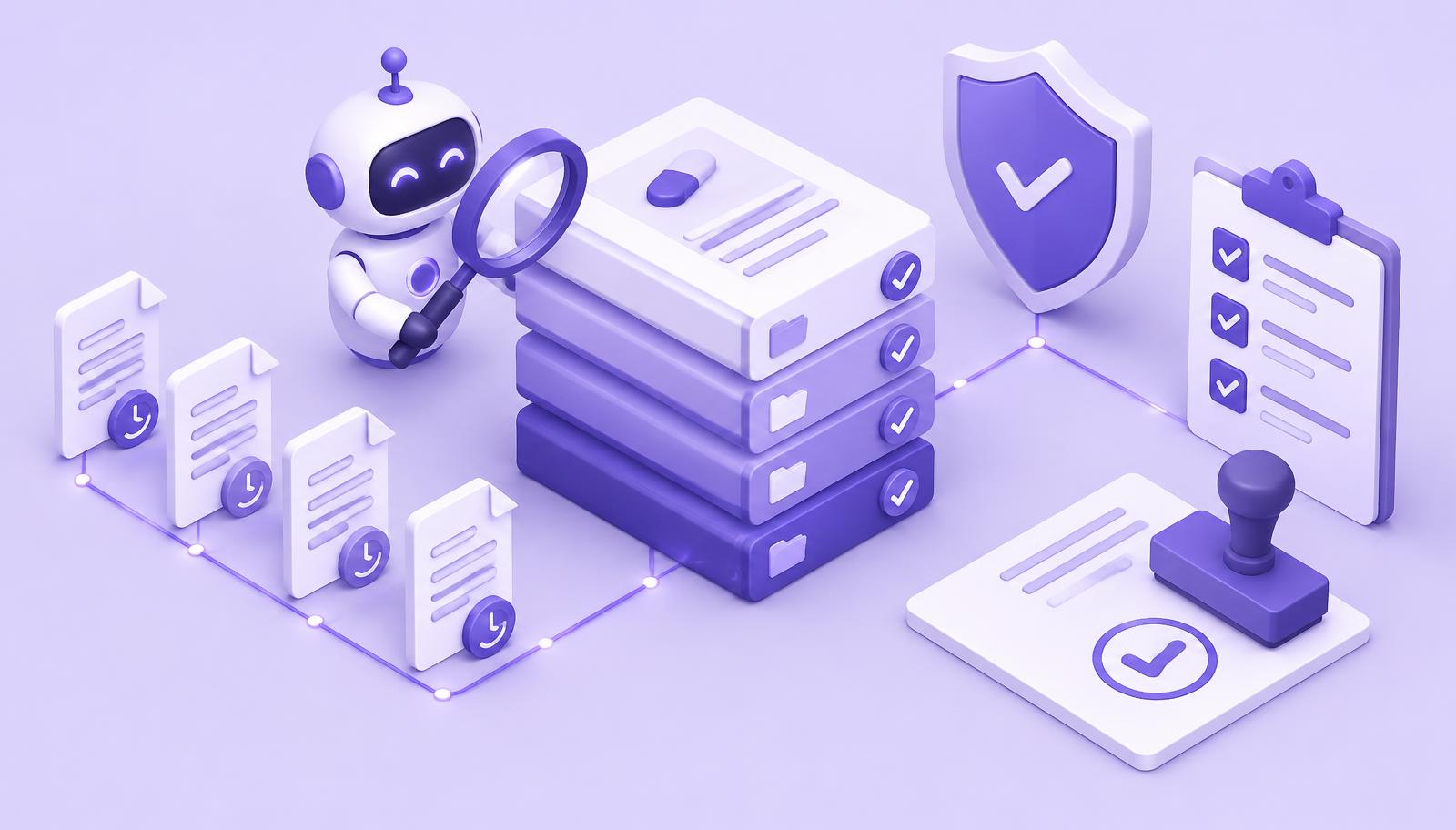
How do agents help? They track which documents depend on which sources, flag every affected document when a source changes, route each discrepancy to its owner, and record how it was resolved. Agents check; qualified people decide.
This blog covers where agents fit in regulatory & submission processes, how they support eCTD readiness, what stays with experts, how to govern the work, and where to start. For the wider picture, see AI Agents in Clinical Trials: The Complete Guide.
Why Is Submission Readiness a Cross-Functional Execution Problem?
A regulatory dossier is built from evidence that different teams produce, review, and approve at different times.
Data management, biostatistics, medical writing, pharmacovigilance, quality assurance, and regulatory affairs all contribute to the dossier. A change made by one team may require review or updates by others. For example, a late update to an adverse-event analysis, may affect:
- Safety tables and listings
- CSR narratives
- Integrated safety summaries
- Relevant summaries and overviews in Module 2
- Related quality-control and approval records
The ICH Common Technical Document (CTD) spreads regulatory information across five modules, so summaries must stay consistent with the evidence behind them [1].
Where Does Agentic AI Fit in Regulatory Operations?
Agents can support defined, multi-step workflows, such as reviewing documents, tracking discrepancies, and coordinating review activities.
Traditional regulatory submission automation means rule-based tools, such as publishing scripts, template population, and standalone validators, that each handle a single, predefined task in isolation. Governed AI agents can connect related checks across a workflow and route exceptions to the appropriate reviewer, subject to approved workflow rules and permissions.
| Regulatory workflow | What the AI agent does | What people decide |
|---|---|---|
| Document completeness | Flags missing or outdated documents | Confirm required content |
| Content consistency | Flags conflict between documents | Confirm scientific accuracy |
| Version reconciliation | Tracks changes and affected documents | Approve revisions |
| Reference verification | Checks citations against approved sources | Confirm how evidence is interpreted |
| Submission preparation | Runs publishing-readiness checks | Authorize final release |
Agents work alongside existing document-management, content-management, and publishing systems . For teams evaluating AI for regulatory affairs, that is the key point: agents can handle repeatable checks and workflow coordination should be under defined controls, while qualified professionals keep scientific and regulatory accountability.
How Can AI Agents Improve Document Completeness and Consistency?
Agents compare submission documents against approved content lists, designated source evidence, and predefined consistency rules.
Document Completeness Checks
To support regulatory document completeness, agents confirm that required documents, appendices, signatures, and supporting analyses are present and approved, and flag missing, unapproved, outdated, or misfiled documents so that submission document review starts from a complete set before publishing begins.
Cross-Document Consistency Checks
Agents can compare corresponding information across CSRs, clinical summaries, protocols, and analysis outputs, flagging potential inconsistencies in items such as:
- Study populations and patient counts
- Endpoint descriptions
- Data cut-off dates
- Adverse-event totals
- Statistical analysis references
Not every difference is an error. Different analysis of populations, data cut-off dates, or reporting contexts can legitimately produce different numbers. The agent's output should be a discrepancy which is supposed to be logged for review, never an automatic correction.
Consistency checks are only as reliable as the sources they compare against. Each key fact should have one upstream source of truth, such as a locked analysis dataset or an approved statistical output, with a named owner who is accountable for it. The downstream rule follows: documents cite that source directly rather than copying the figure from another summary, so a change made upstream can be traced to every document that depends on it. For how agents support data quality upstream, see Agentic AI in Clinical Data Management.
What Is eCTD Readiness, and How Can AI Agents Support It?
eCTD readiness involves both technical conformance and content readiness. eCTD publishing and validation tools perform checks against applicable technical specifications, while AI agents can support related document-level checks, such as version status, content consistency, and the tracking of unresolved discrepancies.
- Check early, not just at publishing: review document placement, metadata, file properties, and hyperlinks as documents are added, so problems surface weeks before the final build.
- Connect technical and content readiness: before a document goes into a sequence, use document version control to confirm it is the latest approved version, check that its approval status is final, and confirm it has no unresolved discrepancies.
- Verify sequence changes: confirm that every document marked as new, replaced, or deleted matches what was actually approved.
- Route validation findings: send each error to the right document owner or publisher and track it until it is resolved.
Passing technical validation confirms that the package is structurally sound. It does not confirm that the data are interpreted correctly or that every claim is adequately supported by the evidence That judgment stays with qualified reviewers.
What Changed in FDA eCTD Requirements in 2026 and 2027?
FDA updated its eCTD v4.0 validation criteria on October 16, 2026 [2]. On the same date, it began accepting forward compatibility for existing v3.2.2 applications; new v4.0 applications have been accepted since September 16, 2024 [3].
With two versions in play, publishing checks must match the version being used. Sponsors should review FDA specifications together with the ICH M8 eCTD v4.0 Implementation Package [4].
Looking ahead to 2027: FDA has announced that, beginning January 16, 2027, it will reject electronic submissions that fail newly designated high-severity validations: validations 2024 and 2025 for eCTD v3.2.2, and eCTD4-084, eCTD4-085, and US-eCTD4-561 through US-eCTD4-564 for eCTD v4.0 [8]. These are technical rejection criteria: a submission that fails them is rejected before scientific review begins, so the fix costs a resubmission and lost time. Publishing teams should confirm that their validation tools apply the updated Specifications for eCTD Validation Criteria and Specifications for eCTD v4.0 Validation Criteria, and agents can help by routing each high-severity finding to its document owner well before the filing date.
How Can Agents Reduce Version Reconciliation and Reference Errors?
Agents can help identify every document that depends on a revised source and track whether each one has been reviewed.
For a late change to a statistical output, an agent could:
- 1.Identify the new version of the analysis.
- 2.Identify documents that still cite the old output.
- 3.Compare the affected tables, figures, and text.
- 4.Log potential discrepancies and route them to the relevant document owners.
- 5.Track reviewer decisions and approved revisions.
The result is a change-impact record: what changed, which documents it affects, and whether each has been reviewed. Reference checks should also confirm that each citation points to the correct approved evidence, not just to a file that opens.
AI-Assisted Medical Writing vs Regulatory Decision-Making
AI-assisted regulatory writing can help prepare documents and check sources, but it cannot replace qualified judgment.
| AI-assisted medical writing | Regulatory decision-making | |
|---|---|---|
| Who is responsible | AI agent, with writer review | Qualified scientific and regulatory experts |
| Typical tasks | Draft structured sections, summarize approved changes, check terminology | Judge whether efficacy claims are justified, interpret safety findings |
| Role with evidence | Flags statements not supported by source data | Decides what the evidence means |
| Output | Draft text and flagged issues for review | Approved conclusions and regulatory positions |
| Final authority | None; every output need human review | Signs off and is accountable for the submission |
What Does FDA Guidance Say About AI?
FDA's January 2025 draft guidance, Considerations for the Use of Artificial Intelligence to Support Regulatory Decision-Making for Drug and Biological Products, proposes a risk-credibility assessment framework for AI models that produce data, supporting regulatory decisions. It treats operational uses, such as drafting submissions, differently when they do not affect patient safety, product quality, or the reliability of study results [5]. That does not exempt AI regulatory writing from normal quality controls.
The FDA–EMA Guiding Principles of Good AI Practice in Drug Development published in January 2026 add emphasis on a defined context of use, risk-based assessment, documentation, and lifecycle management [6]. With AI in regulatory affairs, every output should point back to an approved source, so reviewers can check it.
How Can Sponsors Detect Submission Gaps Before Final Assembly?
Check readiness at three separate levels:
| Readiness level | What must be confirmed |
|---|---|
| Evidence readiness | Reported results match the source analyses, and every citation points to the correct approved output |
| Content readiness | Documents are complete, updated, and approved |
| Technical readiness | Files and electronic structure meet publishing specifications |
A document being uploaded to the document management system does not mean it is ready to submit. It must also be the latest version, approved, and consistent with related documents.
What Governance and Validation Do Regulatory AI Agents Require?
Regulatory AI agents need defined permissions, validated workflows, human review checkpoints, and traceable records. These controls address three risks:
- Incorrect or unsupported outputs. AI-generated text can misstate evidence. It requires source-grounded outputs, discrepancy checks, and qualified human review before approval.
- Uncontrolled document changes. Agents should never change approved conclusions or release documents on their own. Limit system permissions and authorize human sign-off at defined checkpoints.
- Missing traceability. Teams must see which source, document versions, and rule led to each AI-supported action. Maintain reviewable records of changes, reviewer decisions, and approvals.
FDA's guidance, Electronic Systems, Electronic Records, and Electronic Signatures in Clinical Investigations: Questions and Answers, sets out principles for trustworthy and reliable electronic records, including audit trails and electronic signatures [7]. These records support, but do not replace, the human sign-off that keeps accountability with qualified professionals. For more on designing those human review checkpoints, read Human-in-the-Loop AI in Clinical Trials.
Which KPIs Should Regulatory Teams Track?
Regulatory teams should measure how well discrepancies are resolved, not just how many documents were processed.
- Late discrepancy rate: issues found after the content-freeze date.
- Document review cycles: number of review rounds before a document is approved, a direct indicator of submission rework.
- Change propagation time: time to update all affected documents after a source change.
- First-pass quality control (QC) acceptance: share of documents that pass first-pass review without correction.
- Traceability coverage: share of critical references linked to approved evidence.
Compare each against a recorded baseline.
How Should Sponsors and CROs Adopt AI Agents?
Sponsors and CROs should start with one controlled reconciliation workflow, measure a baseline, and expand only after validation.
- 1.Pick the bottleneck: a recurring consistency or version-control problem.
- 2.Define the sources of truth: approved source documents, the document repositories that hold them, the metadata that identifies current versions and approval status, and the review owner for each.
- 3.Start with read-only checks: run human-reviewed AI workflows in which agents compare and flag, and people decide, before agents take any workflow action.
- 4.Validate performance: measure missed discrepancies, false alarms, and reviewer effort.
- 5.Expand under governance: add exception routing and selected eCTD automation checks once approved.
Conclusion: Make Submission Readiness a Continuous Discipline
Late-stage rework usually starts much earlier, when an approved change doesn't reach every document that depends on it. Agentic AI for regulatory submissions helps teams find these gaps, coordinate fixes, and keep traceable records well before filing deadlines.
Frequently Asked Questions
Frequently asked questions
1. What is agentic AI for regulatory submissions?
2. Can regulatory submission automation replace regulatory affairs teams?
3. How is regulatory affairs AI different from AI regulatory writing?
4. Can eCTD automation ensure regulatory compliance?
5. What is the best first AI use case for submission readiness?
References
Sources & references
- International Council for Harmonisation (ICH). Common Technical Document — M4.
- U.S. Food and Drug Administration. eCTD Submission Standards for eCTD v4.0 and Regional M1. Updated October 16, 2026.
- U.S. Food and Drug Administration. Electronic Common Technical Document (eCTD) v4.0. 2026.
- International Council for Harmonisation. eCTD v4.0 Implementation Package. Updated August 2026.
- U.S. Food and Drug Administration. Considerations for the Use of Artificial Intelligence to Support Regulatory Decision-Making. Draft guidance, January 2025.
- U.S. Food and Drug Administration and European Medicines Agency. Guiding Principles of Good AI Practice in Drug Development. January 2026.
- U.S. Food and Drug Administration. Electronic Systems, Electronic Records, and Electronic Signatures in Clinical Investigations: Questions and Answers. Final guidance, October 2024.
- Federal Register (public inspection). FDA notice on high-severity eCTD validation rejections, document 2026-21195.

About the author
Dr. Rachel Bennett
Director, Clinical AI Governance
Dr. Rachel Bennett specializes in human-in-the-loop AI, clinical AI governance, and validation across regulated clinical research workflows.