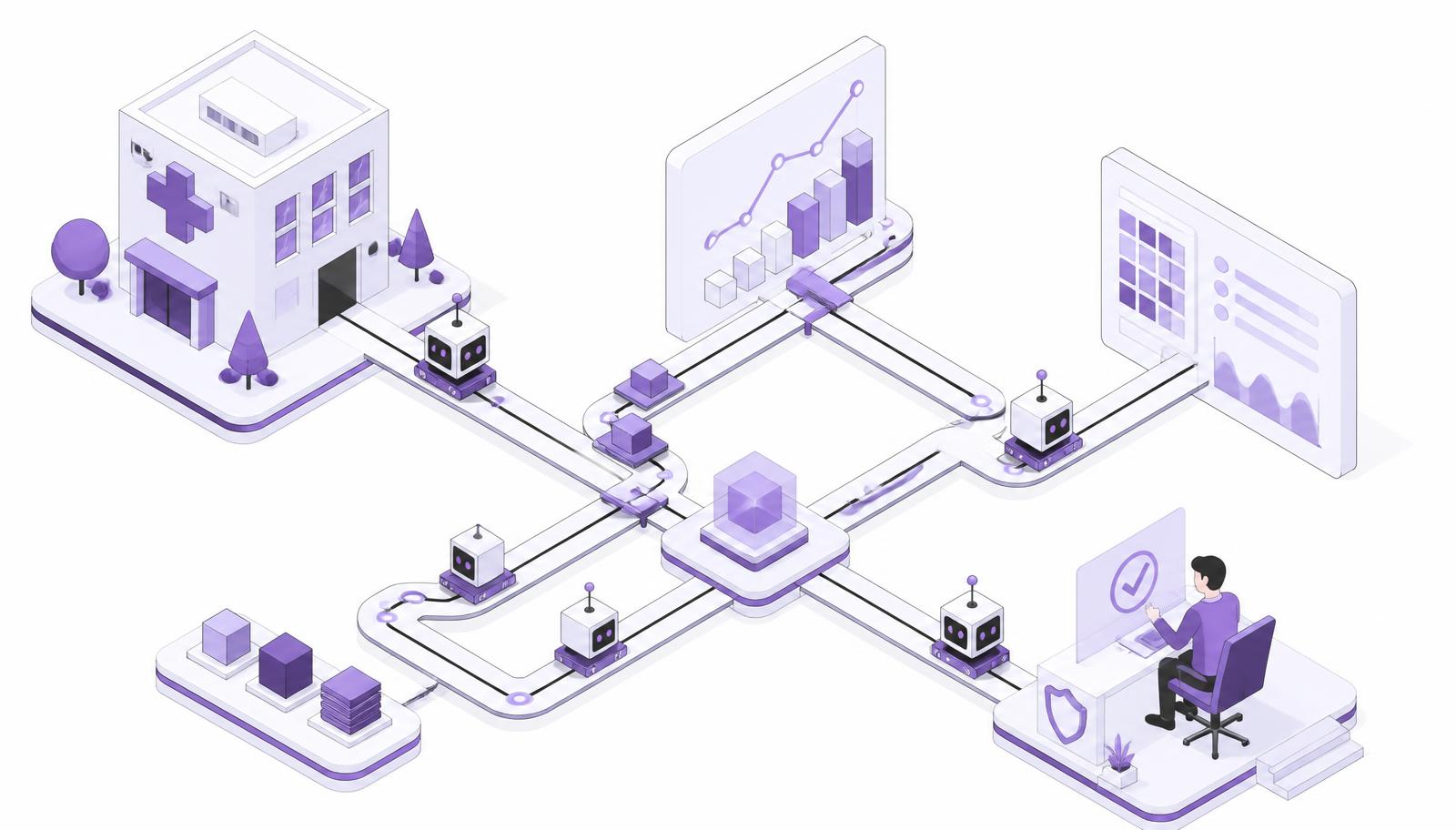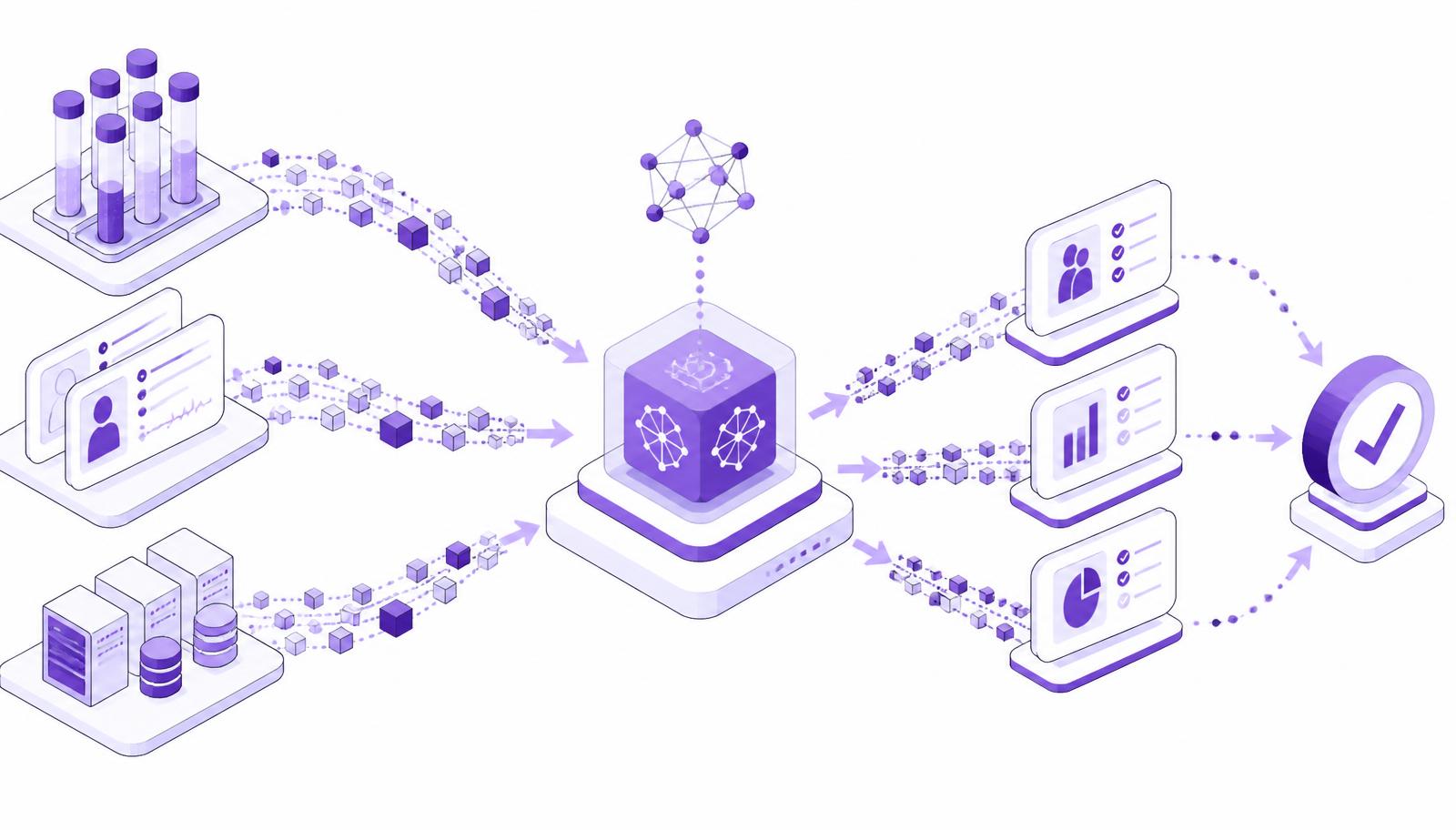
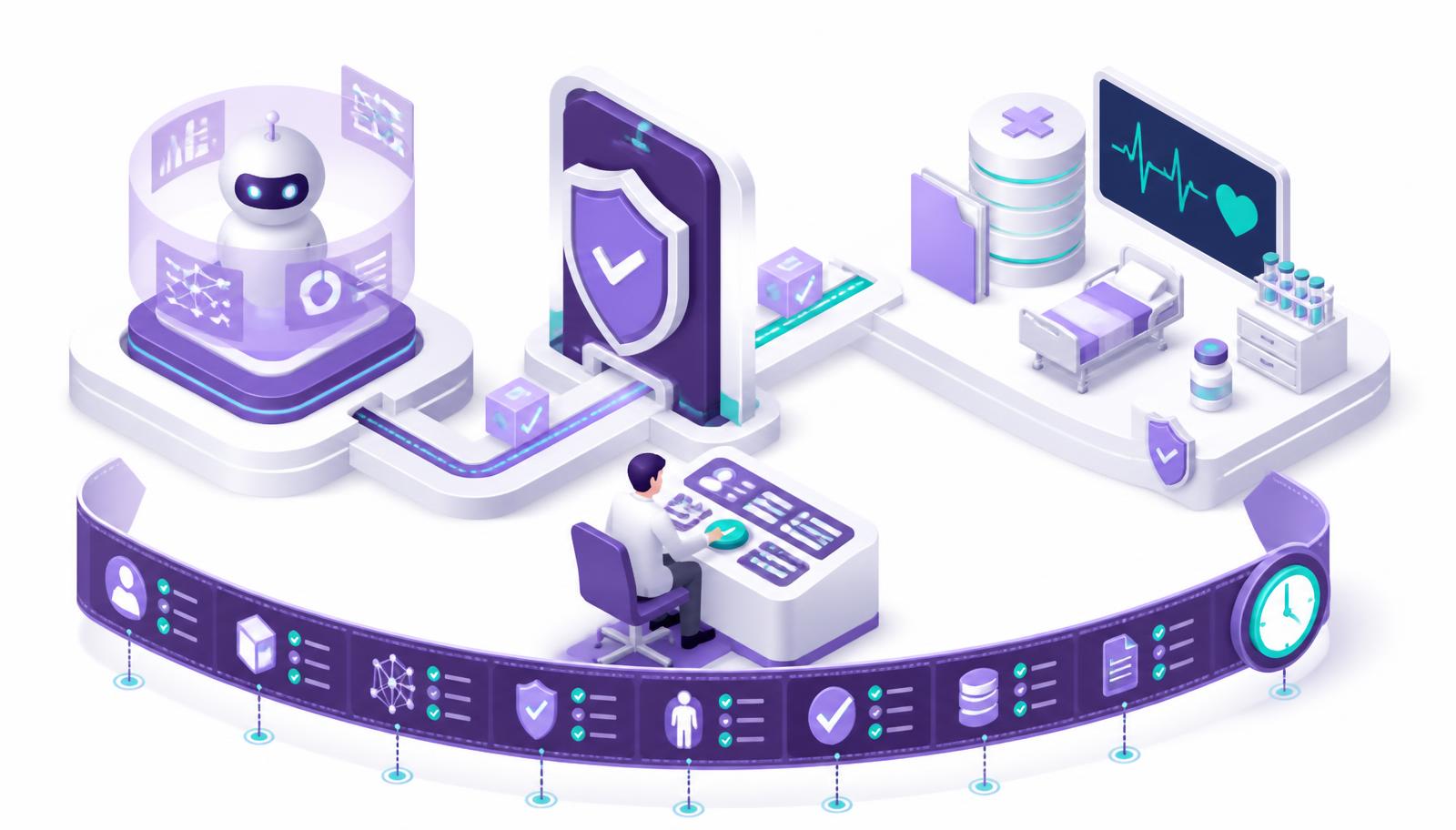
In traditional automation, a system follows a rigid if-this-then-that script. In agentic AI models, the system uses reasoning to decide how to reach a goal. Human-in-the-loop AI in clinical trials is the governance framework that ensures this reasoning never drifts outside the protocol or GxP boundaries.
It is a collaborative framework where human judgment is integrated into how AI models are used, ensuring that high-risk decisions are escalated to a human before any system action occurs. In this model, AI is not a black-box replacement for expertise, but an extension of it.
For background on how AI agents operate, see How Do AI Agents Work in Clinical Trials?. For the full governance framework, see AI Agents in Clinical Trials: The Complete Guide.
Why human-in-the-loop AI is important in clinical trials
As protocols grow more complex and site networks expand, organizations are hitting a capacity failure. Real-time dashboards are excellent at detecting risks, but the human bandwidth required to act on those risks — resolving queries, retraining sites, updating vendors — has not increased.
If you deploy unsupervised AI to bridge this gap, you risk silent failures where an AI incorrectly closes a query or misroutes a safety signal without anyone knowing. HITL provides the controlled execution infrastructure needed to scale trial operations without increasing the risk profile of the study.
How the supervised execution loop works
- Observation (data ingestion): the AI agent monitors live trial streams — EDC entries, CTMS milestones, or eTMF uploads.
- Reasoning (contextual analysis): the AI evaluates the data against the study-specific rules of engagement.
- Validation (the guardrail): the AI checks its planned action against a human-defined threshold. If the confidence score is low or the risk is high, it stops.
- Action or escalation: low-risk actions are logged as bounded execution; high-risk cases are presented to a human expert with evidence and a recommended next step for authorization.
Three HITL oversight models in clinical trials
Human-in-the-loop AI does not work as one fixed approval process. The level of human oversight should change based on workflow risk, data sensitivity, system maturity, and the potential impact of an incorrect action.

1. Assist mode: the agent recommends, the human acts
Assist mode is the most controlled model. The AI agent observes information, identifies issues, and prepares recommendations, but the human user remains responsible for taking every action in the system. The agent has no direct write access to the database or regulated system.
- Best for: new workflows, safety-sensitive data, early-phase studies, oncology trials, and any use case where agent accuracy has not yet been validated in the organization's environment.
- Audit trail: record what the agent observed, what it recommended, and what action the human ultimately took.
2. Execute with approval: the agent prepares, the human confirms
The AI agent prepares the full action — drafting a query, targeting a site, routing a case, or preparing a reconciliation action — and places it in a pending queue. The human performs the gatekeeper function, approving, rejecting, or editing the prepared action before it reaches the system.
- Best for: query management, document reconciliation, site-level follow-up, notification routing, and case pre-classification where workflow logic is validated but human accountability is still required.
- Audit trail: capture the agent's prepared action, the reviewer's identity, the approval timestamp, the final decision, and the confirmed system action.
3. Bounded autonomy: the agent acts within approved rules
Bounded autonomy applies to high-volume workflows with validated rules and clear escalation paths. It does not mean full autonomy — it means controlled execution within a narrow, approved workflow boundary. The human manages the exception queue, reviewing cases the agent cannot classify or that cross risk thresholds.
- Best for: late data entry reminders, routine administrative routing, high-volume data cleaning after validation, and other low-risk repetitive tasks.
| Oversight model | AI agent role | Human role | Best use |
|---|---|---|---|
| Assist mode | Recommends or drafts | Reviews and acts | New or high-risk workflows |
| Execute with approval | Prepares the action | Approves before release | Validated medium-risk workflows |
| Bounded autonomy | Acts within approved rules | Reviews exceptions | Low-risk, high-volume tasks |
How HITL ensures AI compliance and GxP integrity
- FDA risk-based expectations: current FDA guidance on AI in drug development emphasizes a risk-based approach. Intended use, workflow boundary, oversight model, and credibility assessment should be documented before deployment.
- 21 CFR Part 11 alignment: governed AI workflows need role-based access, time-stamped records, and audit trails that show what the AI observed, what it proposed, and which human reviewed or authorized the action.
This is why HITL cannot be treated as a generic approval button. It has to be part of the workflow architecture: who reviews, when they review, what they can approve, and how the decision is recorded.
5 questions to evaluate a vendor's HITL AI claims
- Can a human pause AI-supported actions immediately? Look for a clear control mechanism that can stop agent-led execution within a workflow.
- Does the audit trail show the reasoning path — what data was reviewed, what rule or threshold applied, what action was proposed, and who reviewed it?
- How are escalation thresholds defined? Teams should be able to define which data points, workflows, or risk levels require human authorization.
- Is the approval event part of the record, with reviewer identity, timestamp, decision, and final action taken?
- How is model or workflow drift managed? There should be a documented process for correcting, testing, approving, and releasing changes to AI logic or workflow configuration.
Key takeaways
- HITL defines how AI acts: human-in-the-loop governance controls when AI can recommend, prepare, execute, or escalate.
- Governance protects execution: a supervised execution layer helps prevent small AI errors from becoming systemic quality or audit issues.
- Traceability matters: HITL supports Part 11 alignment by making AI-supported actions attributable, reviewable, and traceable.
- Oversight should match workflow risk: safety, data correction, regulatory, and patient-facing workflows need stronger human checkpoints than low-risk administrative tasks.
The Maxis AI approach: building scalable trust
The Maxis AI Workforce for Clinical Trials is designed as a supervised execution layer for regulated clinical workflows. It supports defined operational actions while preserving human validation checkpoints, role-based permissions, audit traceability, and controlled escalation.
The model starts with a bounded workflow scope. Teams can begin in assist mode, progress to execute with approval, and consider bounded execution only after workflow rules, validation evidence, and governance controls are established.
Conclusion
Effective human-in-the-loop AI bridges the gap between risk detection and governed action. The value is not AI acting without oversight. The value is a controlled operating model where routine work moves faster, exceptions reach the right experts, and every action remains traceable.
Explore how governed AI agents work across specific trial functions: clinical data management, patient recruitment, safety and pharmacovigilance, and RBQM and site oversight.
Frequently asked questions
What is human-in-the-loop AI in clinical trials?
Why is human-in-the-loop AI important in clinical trials?
How does HITL AI improve clinical trial compliance?
What is the difference between HITL AI and automation in clinical trials?
What are the main HITL oversight models in clinical trials?
References
Sources & references
- Human-in-the-loop artificial intelligence in healthcare: applications, outcomes, and implementation challenges — PubMed Central
- Artificial Intelligence and Machine Learning in Drug Development — U.S. Food and Drug Administration
- Part 11, Electronic Records; Electronic Signatures — Scope and Application — U.S. Food and Drug Administration

About the author
Dr. Rachel Bennett
Director, Clinical AI Governance
Dr. Rachel Bennett specializes in human-in-the-loop AI, clinical AI governance, and validation across regulated clinical research workflows.